Agent handoffs tend to fail for a simple reason: teams confuse more context with better context. When one agent passes its full history forward, the receiving agent often inherits too much noise, too many assumptions, and too little clarity about what it is actually expected to do next. The result is a system that feels collaborative but becomes harder to trust at each transfer point.
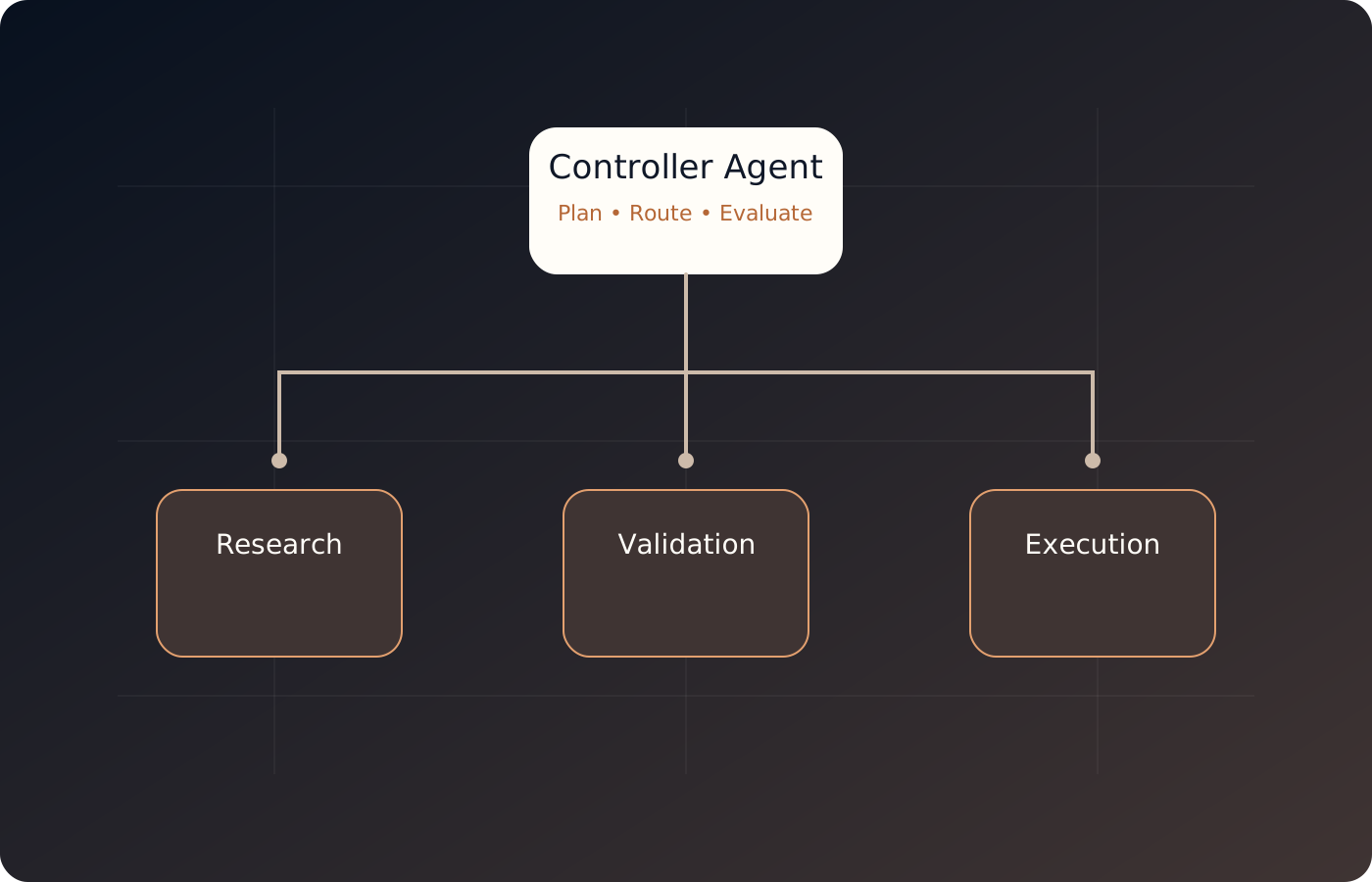
This article is for teams building multi-agent workflows where tasks move between planner agents, researchers, validators, or execution specialists. The aim is to make handoffs smaller, clearer, and more reliable by deciding what must travel forward, what should stay behind, and how the receiving agent should know whether the handoff is complete.
Why handoffs are the first place agent systems become fragile
A handoff is where one local reasoning context ends and another begins. That boundary is useful because it lets specialists stay focused. It is also risky because the team has to decide which facts are essential for the next step. If that decision is implicit, the receiving agent starts guessing about missing intent or working from outdated assumptions.
Most handoff failures fall into one of three categories:
- too much context, which buries the actual task
- too little context, which forces the receiving agent to reconstruct the problem
- missing completion rules, which makes it unclear whether the returned result is ready for use
Use a context packet instead of a transcript dump
The most dependable way to move work between agents is a compact context packet. This is not a copy of the whole interaction. It is a structured handoff that explains the task, the evidence, the constraints, and the expected output in the smallest form the next step can use safely.
A useful context packet usually includes:
- the immediate objective
- the evidence or facts already established
- the constraints or boundaries that matter
- the exact output the next agent should return
- what the receiving agent is not expected to decide
This last element matters more than many teams expect. Telling an agent what it should not decide prevents role drift during delegation.
Differentiate between durable context and local working notes
Not every detail deserves to move forward. Some information is durable and belongs to the workflow state because it matters across multiple steps. Other information is local working memory that helped one specialist reason through a task but does not need to travel to the next one.
Durable context examples
- customer or entity identifiers
- approved workflow goals
- policy constraints and escalation rules
- validated evidence that later steps depend on
Local-only context examples
- scratch reasoning that produced an intermediate hypothesis
- tool output that was already summarized into a durable fact
- rejected branches that no longer affect the next action
Every handoff needs a return contract
The receiving agent should know not only what to do, but how to return work in a shape the controller can evaluate. A good return contract keeps results small enough to compare and specific enough to act on.
A return contract should answer:
- What fields must be present in the response?
- What evidence supports the recommendation or outcome?
- What uncertainty remains?
- What next action does the controller need to decide?
Without this structure, the controller is forced to interpret loosely formatted results, which often reintroduces ambiguity at the exact point where the system should be converging.
Handoffs should shrink, not expand, task scope
A common anti-pattern is using handoffs as a way to broaden the work. The planner hands a task to a specialist, the specialist reinterprets it, and suddenly the workflow contains more objectives than it started with. This often feels like initiative, but it creates brittle workflows because no one owns the new scope explicitly.
Good handoffs narrow the question. The receiving agent should be working on a more bounded problem than the one the controller originally faced, not a wider one.
What to trace around handoffs
If you want to improve handoff quality over time, trace the transfer itself, not just the downstream output. The system should preserve enough information to answer whether a failure came from weak context, weak execution, or a poor evaluation rule after the result returned.
- Record the packet fields sent forward.
- Record the receiving agent's task boundary.
- Record whether the return contract was met.
- Record whether the controller accepted, retried, or escalated the result.
When a handoff should go to a human instead
Some transfers are too risky to stay agent-to-agent. If the next step involves irreversible side effects, policy-sensitive judgment, or missing evidence that the workflow cannot safely reconstruct, the correct handoff target may be a human operator rather than another model.
That is not a failure of the system. It is a sign the workflow understands its own limits.
FAQ
How short should a context packet be?
As short as possible while still making the receiving task safe. The right measure is not token count alone, but whether the packet gives the next agent enough to act without re-discovering basic facts.
Should specialists be allowed to request more context?
Yes, but the request path should be explicit. If specialists constantly need more context, the handoff design likely needs to be improved rather than patched with larger default packets.
Can one context packet serve multiple specialists?
Sometimes, but only if the specialists share the same objective and evaluation rule. Otherwise, each should receive a packet tailored to its bounded role.
How to judge whether handoff quality is improving
Better handoffs produce fewer retries caused by missing context, fewer contradictory specialist responses, and faster operator diagnosis when a branch goes wrong.
- Rate of retries caused by unclear delegation
- Number of handoffs that return incomplete fields
- Percentage of transfers that require manual context reconstruction
- Time to identify where a delegation chain broke down
Conclusion
Agent handoffs become reliable when they behave like contracts, not vibes. Move only the context the next step genuinely needs, distinguish durable facts from local notes, and require a clear return shape. That discipline keeps a multi-agent system coordinated even when the workflow grows more specialized and more asynchronous over time.