Agent workflows are easy to praise when they work and frustratingly hard to improve when they do not. The core problem is often not model quality. It is visibility. Teams can see that a workflow produced a strange result, but they cannot explain which branch, handoff, tool call, or retry decision pushed the run off course. Without observability, the system remains impressive right up until the moment it becomes expensive.
This article is for operators, platform engineers, and AI product teams who are moving agent systems from prototype to production. The objective is to outline what an observable workflow actually needs, which traces are worth keeping, and how to turn workflow behavior into something a human can inspect and improve.
Why model logs are not enough
Teams often begin with prompt logs and tool call histories. Those are useful, but they do not fully explain workflow behavior. Production observability needs to capture decisions between steps as well as execution inside steps. Otherwise you can see what an agent said, but not why the system chose that branch in the first place.
At minimum, an observable workflow should preserve:
- the workflow id and execution state
- branch creation and closure events
- delegation contracts and returned results
- tool call inputs, outputs, and failures
- retry, escalation, and termination reasons
Think in traces, not just logs
Logs tell you that something happened. Traces tell you how the workflow moved. In a multi-agent system, that distinction matters because operators need to follow the path from intent to side effect, not inspect isolated events in a vacuum.
A useful trace should let someone answer these questions quickly:
- What goal was the workflow trying to satisfy?
- Which agent or subsystem took the next meaningful action?
- What evidence caused the workflow to continue, retry, or escalate?
- Where did the system stop making sense?
Make delegation visible as a first-class event
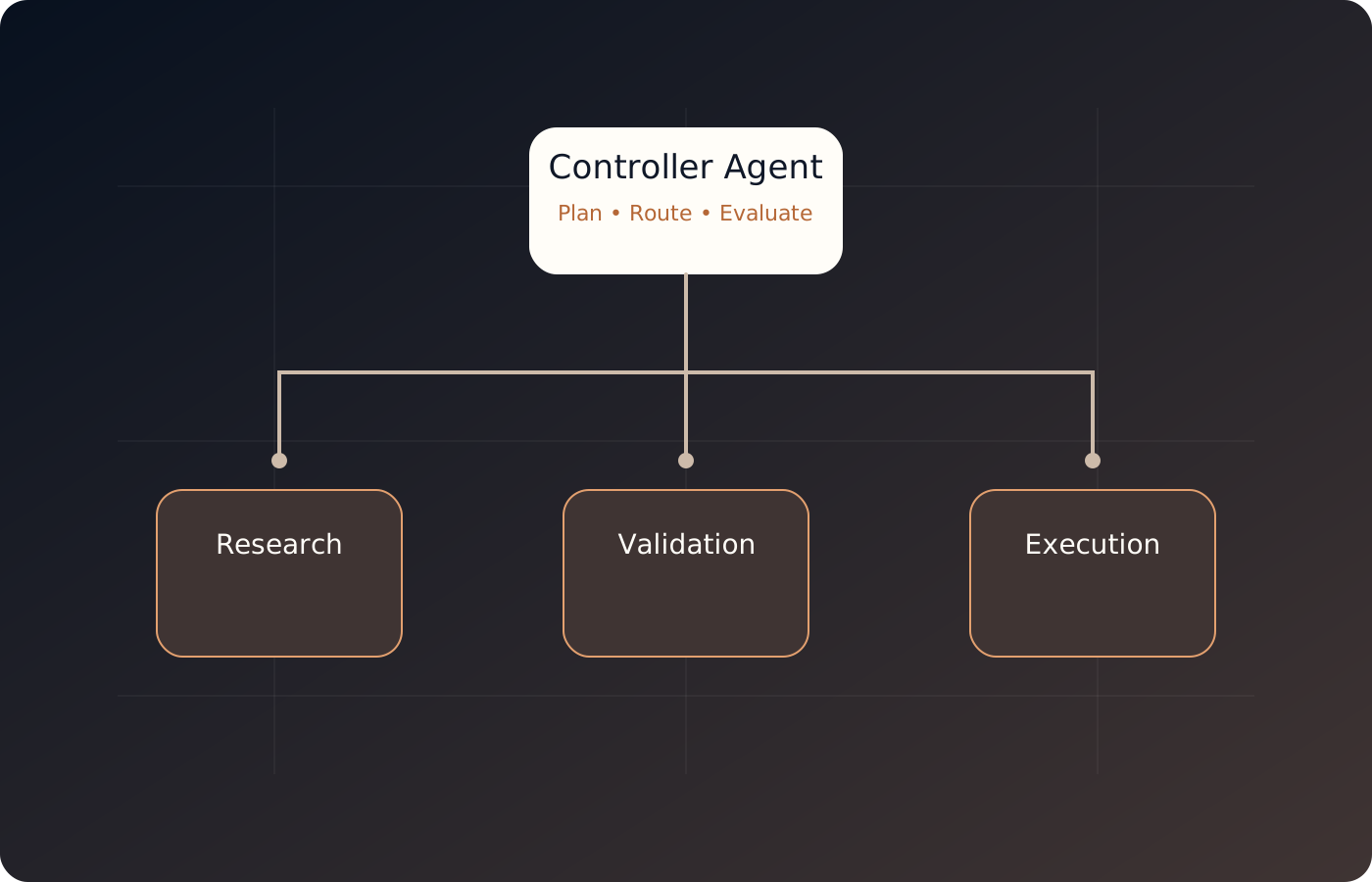
One of the most important observability moves is to treat delegation as a visible workflow event instead of an implementation detail. When a controller agent hands work to a specialist, the system should preserve the handoff packet, the specialist identity, and the evaluation result that came back.
Why this matters
Many agent incidents are diagnosed too late because teams can see the final bad answer but cannot see which transfer made the workflow ambiguous. Delegation traces let you isolate whether the problem came from planning, context transfer, specialist execution, or controller evaluation afterward.
Build failure buckets before you need them
Observability improves dramatically when failures are grouped into categories the team already understands. A bucket does not fix the issue by itself, but it prevents every failure from looking like a unique mystery.
Reasonable buckets often include:
- planning failure
- tool execution failure
- context or handoff failure
- state persistence failure
- evaluation or policy failure
These buckets become useful when retry logic, dashboards, and human escalation paths all speak the same language.
What operators need on the screen
Raw telemetry is not enough. Operators need a view that compresses the workflow into its meaningful decisions. The best operator experiences show the run timeline, the active state, the current branch tree, the last successful checkpoint, and the exact reason the workflow stopped or asked for review.
If a person has to read a full transcript to understand what happened, the system is observable only in theory.
Long-running workflows need resumability in the trace
As soon as a workflow waits for hours, days, or external signals, observability has to survive across time. The trace should show when the workflow paused, what it was waiting on, and which event or human action woke it up later. That history matters because many production failures happen at wake-up boundaries rather than during the initial run.
A good trace for long-running workflows records:
- pause reason
- resume trigger
- state snapshot at pause time
- any policy changes applied before resume
FAQ
How much data should we store for each run?
Store enough to reconstruct the workflow's key decisions and external side effects. The right volume depends on cost and compliance, but the system should always preserve the path needed for debugging and auditability.
Should traces include model reasoning?
Only to the degree that it is safe and genuinely useful. In many cases, structured decision summaries and evaluation outcomes are more operationally valuable than exposing every internal reasoning artifact.
What if dashboards become too noisy?
That is usually a sign the trace schema is event-rich but decision-poor. Compress the view around state changes, delegation boundaries, and recovery events rather than every low-level action equally.
How to judge whether workflow observability is improving
Good observability shortens diagnosis time and reduces the number of runs that need manual reconstruction. It should also improve the team's ability to separate one class of failure from another before opening a major incident.
- Time to identify the failing workflow layer
- Rate of incidents requiring transcript-level manual reconstruction
- Coverage of delegation and retry events in traces
- Operator confidence in deciding whether to retry, resume, or stop
Conclusion
Workflow observability is not just a debug convenience. It is part of the product surface for any serious agent platform. Preserve the decisions that move the workflow forward, show the points where it paused or changed direction, and make delegation, retries, and wake-ups inspectable. That is what turns a powerful demo into a system teams can keep improving after launch.