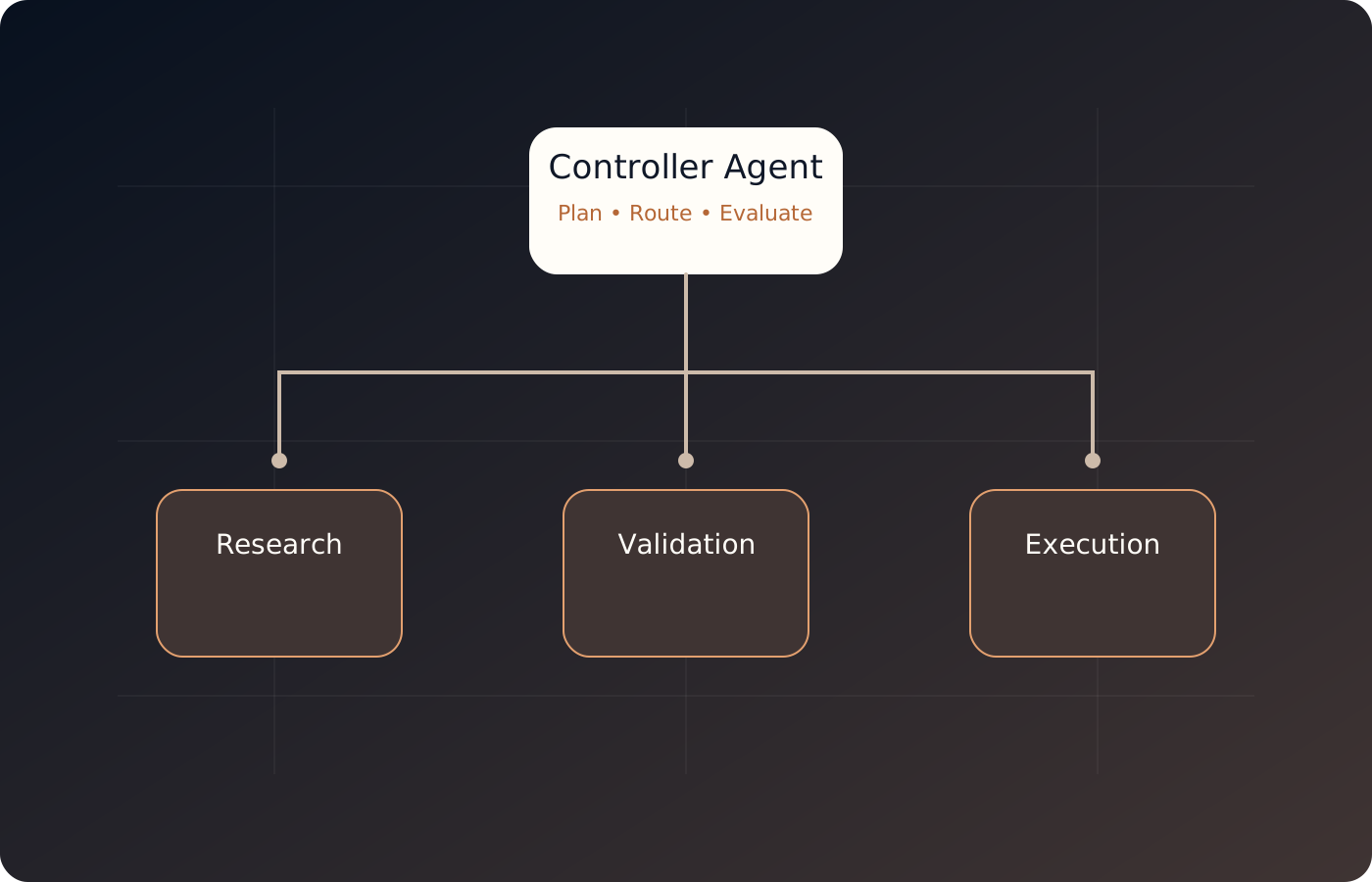
Multi-agent systems become hard to manage long before they become technically impossible to build. The first version often feels impressive: one planner, a few specialist agents, a loop that delegates work, and some tool calls that produce visible momentum. The trouble starts when the system needs to stay understandable after more tools, more paths, and more waiting states show up.
This article is for platform engineers, AI product teams, and technical leads who are deciding how much orchestration a multi-agent system actually needs. The goal is not to celebrate multi-agent design as a default pattern. The goal is to explain when orchestration adds clarity, how a controller agent should behave, and which boundaries keep the workflow readable once real workload pressure arrives.
When a multi-agent system is worth the overhead
A multi-agent architecture makes the most sense when the work naturally breaks into different kinds of responsibility. Research gathering, validation, planning, and external action often have different context needs, risk levels, and evaluation rules. If one agent is forced to do all of those jobs, the system may still work, but it becomes harder to steer and harder to inspect when it fails.
- Use a multi-agent model when the workflow contains multiple bounded tasks with different success criteria.
- Use it when work benefits from parallel investigation or specialist reasoning.
- Use it when the system needs a controller that can decide whether to continue, retry, escalate, or stop.
If the workflow is still mostly linear and single-purpose, a simpler single-agent loop may be the better choice. Extra agents do not automatically create structure. They only create more structure to manage.
Start with a controller agent, not a crowd
The safest starting point is a controller-first architecture. One control agent holds the active plan, decides what task exists next, and chooses whether a specialist is needed. That controller is not there to do all the work itself. It is there to keep the system's reasoning legible enough that operators can explain why a branch was taken.
In practice, the controller should own:
- the current workflow objective
- the list of open tasks or branches
- the contract for each specialist call
- the evaluation rule for deciding what happens after each result returns
Why this matters
Without a clear controller, specialist agents begin to create new work for each other in ways that are difficult to trace. The system starts looking productive while quietly losing the narrative of who owns the next decision.
Specialist agents should have narrow responsibility
A specialist agent is most useful when its responsibility can be described in one sentence and evaluated with a short checklist. That constraint matters because it forces the system designer to define what the specialist is allowed to change, what evidence it needs, and what a complete response looks like when the result returns to the controller.
- Name the specialist for the job it performs, not the technology it uses.
- Define the inputs it receives and the output shape it must return.
- Keep side effects explicit so the controller decides when external actions are safe.
Once a specialist begins making broad strategy decisions on its own, it has effectively become another controller. That is a sign the system's ownership model needs to be redrawn.
State belongs to the workflow runtime, not the prompt transcript
One of the most common mistakes in early multi-agent systems is storing too much workflow state in conversation history. Prompt history is useful for local reasoning, but it is a weak substitute for durable workflow state. As soon as the run pauses, retries, or waits for an external event, the system needs a state model that survives outside the original model context.
A durable state layer should track at least:
- what step the workflow is in
- which tasks are pending, running, blocked, or complete
- which external identifiers or trace ids belong to the run
- which checkpoints require human confirmation before continuing
That separation gives the controller a stable substrate for future decisions instead of forcing every new step to reconstruct system truth from a growing transcript.
Parallelism should be explicit, not accidental
Parallel execution is one of the real advantages of a multi-agent system, but it works only when the controller can explain why two branches may run at the same time and how their results will be reconciled later. Unstructured parallelism creates duplicate work, conflicting conclusions, and more operator confusion than speed.
Good parallelism has a reunion plan
If two specialist agents work in parallel, the controller should already know which result wins when they disagree, what additional validation step resolves a conflict, and whether both outputs are needed before the workflow may continue.
What to trace if you want to improve the system later
Multi-agent orchestration becomes easier to improve when every major decision leaves behind a trace that is meaningful to an operator. Logging only tool calls is not enough. The team also needs to see the decision boundaries around delegation, evaluation, and recovery.
- Record why the controller opened a new task or branch.
- Record what contract a specialist received.
- Record how the returned output was judged.
- Record what caused a retry, escalation, or stop condition.
These traces become the difference between a workflow you can tune and a workflow that remains opaque every time it behaves strangely.
Where multi-agent systems commonly fail
Most failures are not caused by a lack of intelligence. They are caused by weak system boundaries. The controller does not know when to stop, specialists receive vague instructions, state lives only in prompts, or retries continue without clear failure buckets. The result is a system that looks autonomous but behaves unpredictably once complexity increases.
Good failure handling starts by identifying which layer is responsible:
- planning failure in the controller
- execution failure in a specialist or tool call
- state failure in the workflow runtime
- policy failure in evaluation or escalation rules
FAQ
Should every specialist be its own agent?
No. Some tasks are better modeled as ordinary tools or functions. Use a specialist agent only when the task benefits from independent reasoning, bounded context, and a distinct evaluation rule.
How many specialists should a first system have?
Start with as few as possible. One controller and one or two clearly bounded specialists is usually enough to test whether orchestration actually adds value.
When should a human step in?
Before ambiguous synthesis becomes external action, before policy-sensitive output is accepted, and whenever retries are no longer producing new evidence.
How to judge whether orchestration is helping
You should see more than better task completion. A good orchestration model also shortens diagnosis time, reduces duplicate work between specialists, and makes it easier for operators to explain what happened during a run.
- Time to isolate the failing layer
- Rate of duplicate or conflicting specialist work
- Number of runs that required emergency manual reconstruction
- Percentage of branches with a traceable controller decision
Conclusion
The real job of orchestration is not to make a multi-agent system look sophisticated. It is to preserve clarity while the workload becomes more distributed. Start with a controller, keep specialists narrow, move state into the workflow runtime, and trace the decisions that matter. That structure makes the system easier to scale, easier to debug, and much safer to trust in production.